

Key Takeaways
MSCI will remove Strategy from its global indexes effective after the market closes on November 30, 2026.
JPMorgan estimates the decision could trigger around $2.8 billion in selling pressure, potentially rising to $11.6 billion if other index providers follow.
Despite the exclusion, Strategy continues accumulating bitcoin, with its holdings reaching 850,364 BTC.
Why MSCI Is Removing Strategy From Its Indexes
MSCI has confirmed that it will remove bitcoin treasury company Strategy (MSTR) from its global stock indexes, a decision that could lead to billions of dollars in stock sales and put additional pressure on the company's bitcoin buying strategy.
The decision was announced on November 11 as part of MSCI's November 2026 Index Review. The changes will take effect after the market closes on November 30.
Strategy, led by Michael Saylor, is the world's largest corporate holder of bitcoin. The company raises money by selling shares and other securities and uses much of that money to buy more bitcoin.
However, its removal from MSCI indexes could reduce demand for its shares and make it harder for the company to raise money in the future. MSCI says Strategy no longer meets its requirements for companies included in its indexes because its business has become too similar to an investment fund.
The decision follows a review of companies that hold large amounts of financial assets but have limited traditional business operations.
MSCI initially considered excluding companies whose digital asset holdings represented at least 50% of their total assets. However, it later introduced broader rules that apply to companies with different types of investment holdings, not just bitcoin.
Under the new rules, MSCI looks at how much of a company's assets are used in its actual business operations. Companies that fail this first test must pass additional financial tests covering operating expenses, cash flow, assets and dependence on external financing.
A company can become ineligible if it fails at least four of these five additional tests.
Existing index constituents must meet the exclusion conditions across their two most recent annual reporting periods, although MSCI may also consider more recent interim financial statements.
The new methodology was adopted on October 15 and is designed to identify companies that MSCI believes operate more like investment funds than traditional businesses.
Strategy is not the only company affected by MSCI's decision.
Japanese Bitcoin treasury company Metaplanet will also be removed from the MSCI Japan Small Cap Index. Uranium investment company Yellow Cake, Icelandic company Skel Fjárfestingafélag and US-based Upexi are also included in the final list of deletions.
One of the biggest concerns is how MSCI's decision could affect demand for Strategy shares.
Many investment funds track major stock indexes. These funds are generally required to hold shares of companies included in those indexes. When a company is removed, the funds must adjust their portfolios and sell their holdings.
Strategy previously disclosed that funds tracking MSCI's global indexes held approximately 13 million MSTR shares, equal to around 3.1% of its basic shares outstanding.
JPMorgan analysts previously estimated that Strategy's removal could result in approximately $2.8 billion in selling pressure. They also suggested that the total outflows could increase by another $8.8 billion if other major index providers followed MSCI's decision.
It is also important to understand that being removed from MSCI indexes does not mean Strategy will be delisted from the stock market. Nor does it force the company to sell any of its bitcoin.
The immediate impact is on its shares, as investment funds adjust their holdings. Another concern is what the decision could mean for Strategy's ability to raise money.
The company relies heavily on selling new shares and issuing preferred securities to finance its bitcoin purchases. If its stock price continues to fall, raising money through share sales could become less attractive and more difficult.
Still, not everyone believes MSCI's decision will have a major long-term impact.
Market commentator Adrian Morris suggested that investors may have already priced much of the potential selling pressure into MSTR shares.
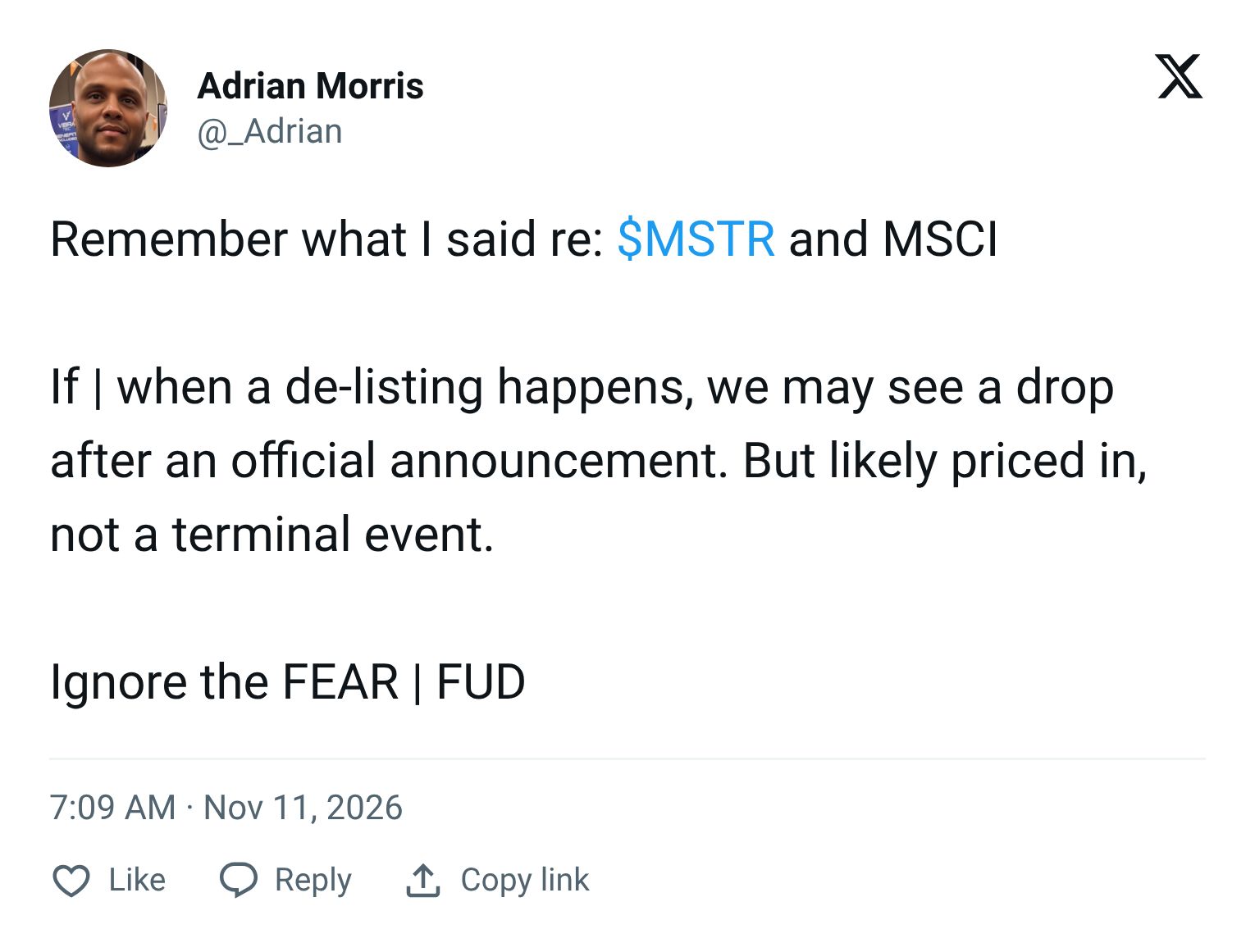
He argued that an official removal could cause another decline but would not necessarily threaten the company's future, describing the event as "likely priced in, not a terminal event."
Despite the pressure on its shares, Strategy has continued to increase its bitcoin holdings. On November 9, the company announced that it had purchased another 1,036 BTC for approximately $81.9 million.
The purchase brought its total holdings to 850,364 BTC, acquired at an average price of $75,456 per coin. The company's total investment in bitcoin reached approximately $64.16 billion.
Strategy has also pushed back against concerns about its removal from MSCI indexes. In an earlier response, the company said that funds tracking MSCI's global indexes held only around 3.1% of its basic shares outstanding.
It also argued that the exclusion would have "no meaningful impact on Strategy's business."


