

Over here in America, the news this week and the financial markets were dominated by the blue tsunami that saw Democrats take commanding majorities in both the House and the Senate.
Exit polls showed many voters treating it as a rebuke of Trump, driven by the war in Iran, the affordability crisis and the growth of data centers.
Bitcoin, coming off a devastating Binance hack, seemed fine with the news. On Wednesday it climbed back above $81,000, nearly erasing its post-hack losses, and rallied with the rest of the market.
However, things reversed quickly on Thursday as the market realized the election results could have serious implications for the AI trade. The Nasdaq had its worst day since April 2025, down 5.5%, and Bitcoin followed suit, falling to $75,000, where it has stayed in a very tight trading range since.
And while Bitcoiners may be upset about the price action getting stuck, what happened in Paraguay this week, where about 3 million Ueno Bank customers lost access to their accounts, was a pivotal lesson in the importance of Bitcoin, which we dive into in the op-ed below.
Also in this week's newsletter:
Square finally realizes its dream of widespread BTC merchant adoption.
Bull Bitcoin becomes the first exchange to make Payjoin the default
Liquid returns to being fully backed by Bitcoin.
Latest News
Adoption
Square finishes rolling out BTC payments to more than 4 million merchants on Nov. 10. Lightning payments settle in seconds, with no fees through Dec. 31 and 1% after that. New York businesses are excluded.
Bull Bitcoin becomes the first exchange to introduce Payjoin deposits and withdrawals, enabling default privacy-enhancing transactions that consolidate UTXOs and complicate blockchain surveillance.
Still Running is a new interactive 3D visualization of Bitcoin that lets users watch live transactions, mining activity, and blocks being confirmed, while tracking their own transactions in real time.
Regulation
Chainalysis takes its compliance tools offline after hackers expose user credentials and live tokens. Every user must reset passwords and API keys, and Coincheck and ICONOMI pause withdrawals.
Former FBI agent Patrick Yaroch pleads guilty to stealing $2.47 million in crypto from 35 investigations through about 100 unauthorized transfers and laundering the funds. He faces up to 20 years in prison.
Greece approves a 10% capital gains tax on Bitcoin and crypto, introducing a comprehensive tax framework while exempting the first €500 in annual profits.
Markets
Paraguay’s central bank seizes Ueno Bank on Nov. 3, locking about 3 million customers out of their money. Central bank chief Carlos Carvallo resigns, and on Nov. 6 the Senate removes President Santiago Peña.
Liquid Network restores 1:1 BTC backing for 4,275 LBTC after September’s exploit, as Blockstream replenishes reserves. BTC swaps have resumed, but direct federation withdrawals remain restricted.
MEXC is being cut off from the US financial system after FinCEN said it moved at least $16 billion in illicit funds from May 2021 to May 2026. The order takes effect 30 days after publication.
Treasury
Michael Saylor argues digital credit took 400 years to develop, tracing financial innovations from 1602 to Bitcoin's creation in 2008, culminating in Strategy's Bitcoin-backed preferred stock, STRC.
Tether now holds 150,000 Bitcoin worth over $11.5 billion, CEO Paolo Ardoino reveals, as the stablecoin issuer continues accumulating BTC alongside $132.4 billion in US Treasuries and $8 billion in reserves.
Mining
Home miner finds Bitcoin block 974238 using a NerdQAxe++ Rev 6, but receives pooled payouts of a couple thousand sats instead of the full block reward of +3 BTC, reigniting debate over solo versus pool mining.
Riot sells 10,599 BTC in the third quarter, 79% of its stack, to build AI data centers. Meanwhile, Core Scientific sells 96% of its Bitcoin and plans to stop mining by year-end.
Elektron Energy’s new report finds BTC mining pool centralization poses limited risks, with similar long-term returns across pools and tools like independent block template construction available to strengthen decentralization.
Politics
Kim Yo Jong, Kim Jong Un's sister, rejects the FBI's claim that North Korea ran the $6.3 billion Binance hack. She suggests the US could be behind it, pointing to its strategic reserve of seized Bitcoin.
Crypto super PACs lose big as Democrats sweep Congress. Of the $92.4 million they spent in competitive races, $74 million backed losers, including $64 million spent against Sherrod Brown, who won.
Elizabeth Warren is expected to chair the Senate Banking Committee in January, giving one of Bitcoin's fiercest critics power over hearings and subpoenas. The appointment isn't final.
THE BITCOINER GIFT GUIDE, BY SOLO SATOSHI
It's November, and that means it’s time to start thinking about gifts for those you care about.
If the Bitcoiner in your life seems to have everything, skip sending them more sats and give them hardware they will actually use.

Solo Satoshi stocks the tools Bitcoiners use to mine, secure and run Bitcoin themselves, at every price point:
Stocking stuffer: a Seed Phrase Dice Set, so they can roll their own seed words instead of trusting a random number generator.
Under $100: a Bitaxe Gamma, the open-source solo miner that sits on a desk and takes its shot at every block.
Under $200: a NerdQaxe++. Last week a NerdQaxe++ found Bitcoin block 974,238. Pointed at a solo pool, the next lucky one could earn a block reward worth more than 3 BTC.
The big one: a Start9 Server One, so they can run their own node instead of asking someone else's server about their balance.
Orders placed before 12 PM CT ship the same day from Conroe, Texas, where Solo Satoshi also runs a storefront that takes Bitcoin, KYC-free.
And if your Bitcoiner needs a hand, the Solo Satoshi team helps with setup, configuration and troubleshooting after the box is opened.
This year, give them a piece of the network.
Bam’s 2 Sats
The Real Risk Isn’t Bitcoin’s Volatility
This was one of those weeks that reminded me why Bitcoin is so important.
And no, it wasn’t because of the US midterm elections or Bitcoin’s wild volatility, which saw its price swing from $75,000 to $81,000 and back to $75,000 in barely 36 hours.
It was because of what has been happening in Paraguay.
When an Entire Country Loses Access to Its Money
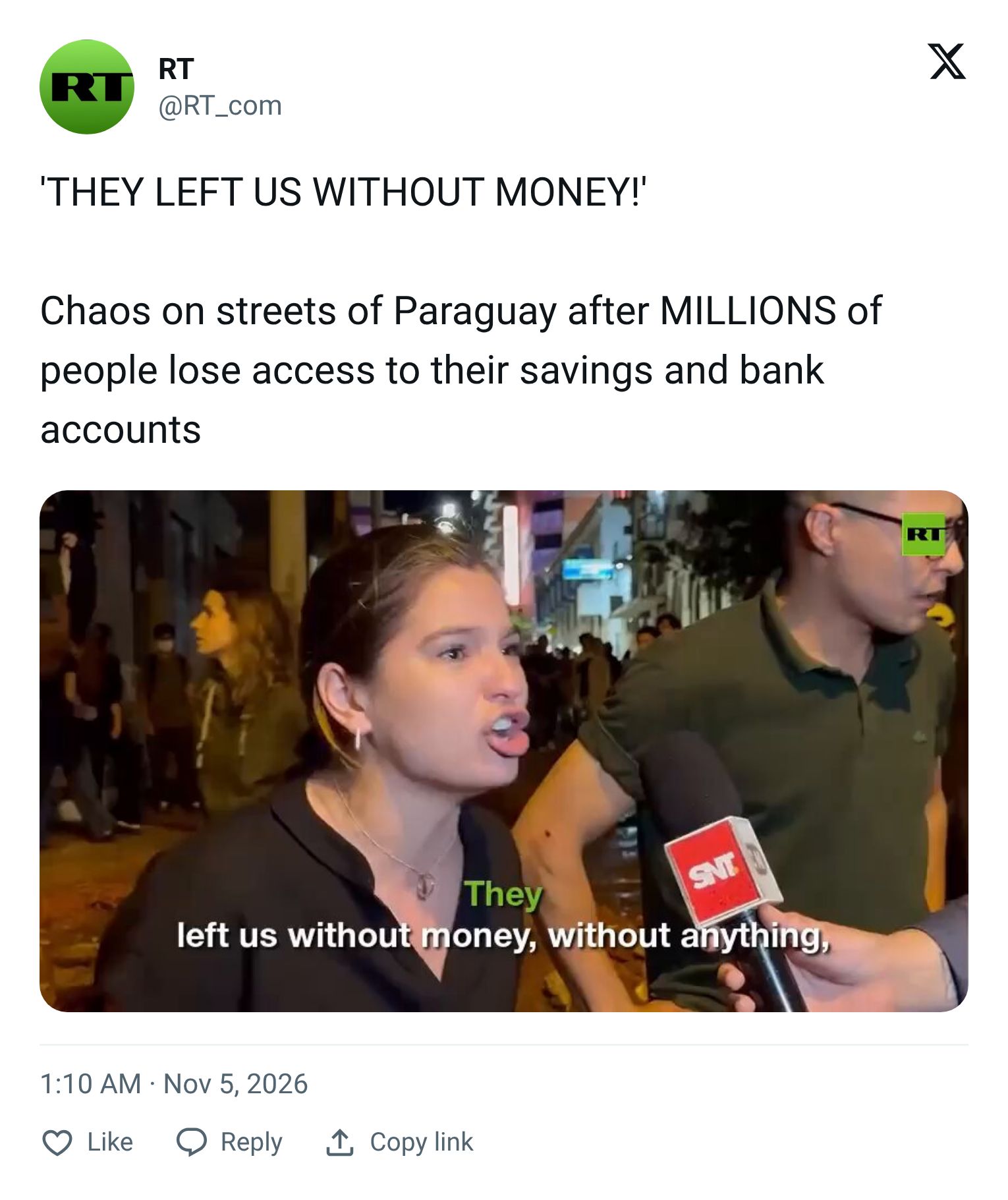
For those who missed it, Paraguay is facing a major banking and political crisis following the reported collapse of Ueno Bank, one of the country’s fastest-growing digital banks.
Ueno reportedly served nearly 60% of Paraguay’s adult population, and as the crisis unfolded, more than 3 million customers were said to have lost access to their accounts practically overnight.
The consequences extended far beyond individual depositors. Public pension and healthcare funds were reportedly caught up in the crisis, while disruptions to payment services affected businesses across the country.
Within days, the Senate removed President Santiago Peña, who now faces charges tied to the bank.

Outside the premises of a Ueno Bank franchise
Naturally, people were furious, with angry depositors gathering outside bank branches to protest and demand access to their money.
But what I found particularly interesting was how people began looking for alternatives.
As the crisis unfolded, USDT reportedly began trading at a premium of roughly 3–5% in parts of the local peer-to-peer market, with some offers reaching as high as 13%.
In other words, people were willing to sacrifice a considerable percentage of their savings just to get their money out of the traditional financial system. They were actively looking for an exit.
To me, this is another reminder of why Bitcoin is so important to the world.
We live under a financial system in which risks and benefits are distributed very unevenly. Ordinary people often bear the consequences when things go wrong, while banks and central authorities retain much of the power.
We rarely question this arrangement because, most of the time, the system works well enough for us to trust it.
But as the reported events in Paraguay illustrate, that trust can disappear almost overnight.
This is fundamentally a problem of counterparty risk, something that fiat currencies and the traditional banking system are full of.
When you deposit money in a bank, you are trusting that institution to give it back whenever you need it. In times of crisis, central banks can create new currency to rescue failing institutions, potentially devaluing the savings of everyone holding that currency.
And in more extreme circumstances, like those reportedly unfolding with Ueno Bank in Paraguay, access to your own money can simply be suspended with the click of a button.
Even when authorities step in, there is no guarantee depositors will regain immediate access to their money.
In Paraguay, the central bank has reportedly begun repaying Ueno Bank customers, but the first round is limited to depositors with balances of $1,565 or less who have no outstanding debts to the bank and maintain accounts at other financial institutions. Everyone else must wait.
Think about that for a moment. You worked for your money, deposited it in a bank for safekeeping, and now someone else gets to decide how much of it you can access and when.
Bitcoin's Volatility Isn't the Only Risk That Matters
The irony is that we spend so much time talking about Bitcoin’s volatility as if it were the greatest financial risk someone could face.
We obsess over whether Bitcoin is worth $75,000 or $81,000, whether the next move will be up or down, and whether we have finally reached the bottom.
Meanwhile, millions of people are being reminded that the money sitting in their bank accounts might not be available when they need it most.

With Bitcoin, however, we have something fundamentally different.
When held in self-custody, nobody can simply freeze your account, no single institution can unilaterally prevent you from transacting, and no central bank can create new bitcoins out of thin air to rescue someone else’s bad decisions.
Of course, Bitcoin comes with its own risks, particularly its volatility and the responsibility of securing your own funds. But at least these are risks we can choose to take ourselves rather than having them imposed on us by someone else.
After all, what good is having money if someone else gets to decide when you can use it?
- Bam


